ULI to Transform Lending Ecosystem in J&K: Chief Secretary Says platform to cut loan processing time to minutes, boost financial inclusion across rural and underserved areas

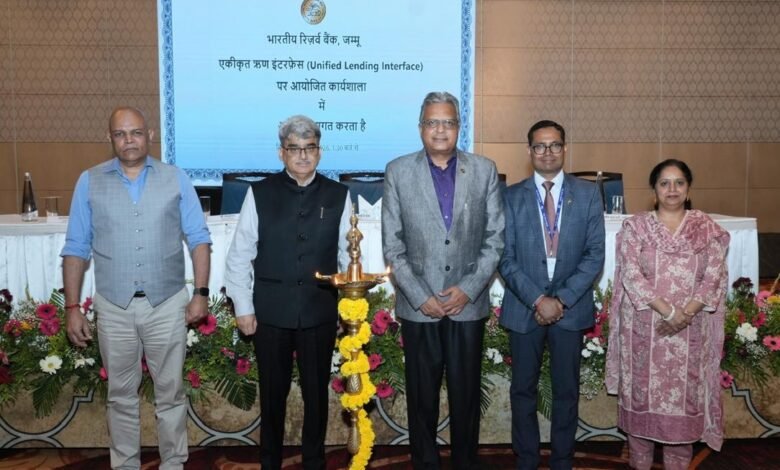
JAMMU, APRIL 07: The Reserve Bank of India (RBI), Jammu today organised a workshop on the Unified Lending Interface (ULI) for officials from various government departments and banks operating in the Union Territories of Jammu & Kashmir and Ladakh.
The workshop was graced by Chief Secretary, Atal Dulloo, as the Chief Guest, and Executive Director, RBI Mumbai, P. Vasudevan, as the Special Guest. The event was held in the presence of Regional Director, RBI Jammu, Chandrashekhar Azad, and attended by senior dignitaries including Dr. Ashish Chandra Verma, Financial Commissioner (ACS), Tourism;Mandeep Kaur, Commissioner Secretary, Housing & Urban Development Department; Secretaries of various departments and senior officials from banks.
Addressing the gathering, Dulloo, described the Unified Lending Interface as a transformative step towards democratising access to credit, ensuring that no deserving entrepreneur, farmer or small business is left behind due to procedural bottlenecks. He highlighted the special relevance of ULI for a hilly region like Jammu & Kashmir, noting that technology-driven integration of data has the potential to compress loan processing timelines from weeks to minutes, thereby ushering in a new era of efficiency, transparency and trust in the lending ecosystem.
The Chief Secretary further observed that ULI would bridge longstanding gaps in credit accessibility, particularly in rural and semi-urban areas, and aligns with the broader vision of financial inclusion for MSMEs, farmers and first-time borrowers. Emphasising the shift from collateral-based to data-driven lending, he noted that the platform would enable institutions to take informed decisions based on verified digital footprints while reducing reliance on physical documentation.
The Chief Secretary also stated that ULI’s interoperable architecture would eliminate fragmentation across data systems, leading to faster and more reliable credit decisions. He stressed the importance of capacity building and stakeholder awareness for optimal utilisation of the platform and commended its plug-and-play architecture, which is expected to lower operational costs and encourage wider participation from fintechs and financial institutions.
He urged all stakeholders to ensure that the benefits of this initiative reach the last mile, empowering farmers, artisans and small entrepreneurs across the districts of the UT.
In his inaugural address, Regional Director, RBI Jammu, Chandrashekhar Azad, welcomed the participants and highlighted that the Unified Lending Interface, conceptualised by the Reserve Bank of India and developed by the Reserve Bank Innovation Hub (RBIH), is designed to enable seamless and frictionless credit delivery. He noted that the platform integrates diverse data sources across the credit ecosystem, thereby improving access to credit, reducing turnaround time and enhancing customer experience.
Describing ULI as the “UPI moment” for the lending sector, he remarked that just as the Unified Payments Interface revolutionised digital payments, ULI has the potential to redefine credit delivery by making it more inclusive, efficient and accessible across the country.
Executive Director, RBI, P. Vasudevan, in his address, highlighted the platform’s potential to transform credit delivery through secure, consent-based access to digital data. He emphasised that ULI aims to reduce delays, improve efficiency and expand access to credit, particularly for farmers, small entrepreneurs and rural sectors. While acknowledging the progress made in financial inclusion, he noted that many borrowers still remain underserved due to the lack of reliable digital data. He encouraged the Government to integrate its datasets through APIs and initiate pilot projects to further strengthen financial inclusion and drive economic growth.
The workshop concluded with detailed presentations and interactive sessions aimed at familiarising stakeholders with the operational aspects and implementation framework of the Unified Lending Interface.