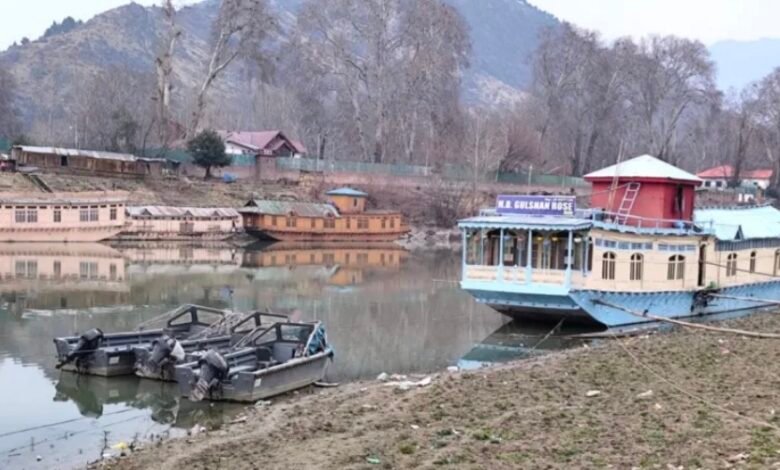
Kashmir’s rivers are showing early signs of ecological collapse, with the Valley experiencing more than 80 per cent rainfall deficit this season. Flows in the Jhelum and its feeder streams have dropped sharply, transforming once-vibrant channels into slow-moving, stagnant stretches. While water continues to flow, scientists warn that aquatic life, especially native fish, is already under stress.
Prof Irfan Ahmad, Professor & Head, Division of Fish Genetics & Biotechnology, Faculty of Fisheries, SKUAST-K, Rangil, told Rising Kashmir that prolonged low flows, caused by rainfall deficit and reduced snow and glacier melt, are steadily lowering dissolved oxygen (DO) levels, particularly in sluggish river sections.
“Dissolved oxygen levels are expected to drop, especially in sluggish stretches of the Jhelum and its tributaries,” Prof Ahmad said. “This directly stresses snow trout, whose physiology depends on cold, oxygen-rich water. Reduced flows slow growth, impair reproduction, and raise mortality risks if hypoxia worsens.”
Although there is no confirmed evidence yet of widespread fish deaths this season, Prof Ahmad cautioned that early warning signs are visible. “Juveniles and eggs are affected first, often at oxygen levels adults can still tolerate. Sub-lethal stress is almost certainly already occurring.” He emphasised: “Low flow does not kill fish immediately, hypoxia does. By the time fish die, physiological damage and recruitment failure have already happened.”
For snow trout, maintaining dissolved oxygen above 6 mg/L during low-flow months is critical for survival. Shrinking rivers are also disrupting fish breeding, migration, and feeding. Indigenous cold-water species, such as snow trout and loaches, spawn in spring to early summer in shallow, flowing riffles with clean gravel and high oxygen levels. Eggs develop in gravel interstices that require continuous oxygen-rich flow.
“Shrinking rivers fundamentally change how fish use space, time, and energy,” Prof Ahmad said. “This disadvantages indigenous species while favoring invasive generalists like common carp.”
Low-flow, stagnant conditions turn cold-water specialists into ecological losers. Altered timing of insect emergence and warmer waters create mismatches for snow trout larvae, while carp larvae thrive on abundant plankton. The result: snow trout survive but fail to reproduce, juveniles disappear first, and carp dominate shallow zones. Over time, the fish community shifts toward warm-water and invasive species—without a single fish kill.
Successful snow trout reproduction depends on multiple conditions: clean, loose gravel; continuous water flow through the gravel; high oxygen at egg level; and unbroken upstream access. During March to May, if riffles dry or disconnect, spawning failure is almost certain.
“Low-flow years are carp recruitment years,” Prof Ahmad said. He stressed that environmental flow during spawning must not fall below 40 percent of mean spring discharge for at least 30 consecutive days. “Anything less is only survival flow. Snow trout can survive drought flows—but they cannot reproduce below about 40 percent of spring flow.”
In the Jhelum system, snow trout need roughly 30 percent of spring flow to attempt spawning, 40 percent to keep eggs alive, and nearly 50 percent to rebuild populations. Adult survival alone cannot prevent collapse if recruitment fails over multiple years. Prof Ahmad outlined a stark threshold for functional extinction: about five consecutive years of spring flows below 40 percent of the long-term mean—often fewer in smaller tributaries. Even if flows later return to normal, populations may remain depressed for two to three generations, or six to twelve years. Fragmented habitats from dams or diversions further accelerate collapse.
Looking ahead, Prof Ahmad warns that if the current dry spell and reduced winter recharge persist, Kashmir’s freshwater fisheries could face severe long-term consequences. Recruitment may collapse, adult populations could decline within three to five years, and smaller tributaries may witness local extinctions.