Sakeena Itoo urges academic leaders to embrace AI with responsibility & ethical values
Addresses valedictory session of two-day Digital Readiness Workshop at KU

SRINAGAR, JUNE 30: Minister for Education, Social Welfare, Health and Medical Education, Sakeena Itoo today urged the academic leaders to embrace Artificial Intelligence (AI) with responsibility and ethical values, adding that AI is reshaping education, governance and virtually every sphere of human activity.
The Minister made these remarks while addressing the valedictory session of two-day Digital Readiness Workshop for Academic Leaders on the theme “Building AI-Ready Institutions” at Kashmir University here today.
The workshop was organised by University of Kashmir ( KU) in collaboration with Intel, bringing together academic leaders, administrators and faculty members to deliberate on leveraging Artificial Intelligence (AI) for academic excellence, institutional transformation and effective governance.
The workshop was organised as part of the University’s continued efforts to promote digital readiness and innovation in higher education, the workshop was designed to equip academic leaders with the knowledge, practical insights and strategic competencies required to integrate AI into teaching-learning processes, research, academic administration and institutional leadership.
Addressing the gathering, Sakeena Itoo described Artificial Intelligence as a transformative force that is reshaping education, governance and virtually every sphere of human activity. She said that AI is steadily becoming an indispensable part of almost every profession and urged academic leaders to equip themselves with the knowledge and skills necessary to harness its immense potential for the greater public good.
Calling for the judicious and ethical use of AI, the Minister said the technology has already demonstrated remarkable capabilities in diverse sectors, including healthcare through early detection of critical diseases, agriculture by improving crop quality assessment and weather forecasting, and disaster mitigation through predictive technologies. She observed that such interventions have the potential to significantly improve governance, decision-making and service delivery when implemented responsibly.
Emphasising the need for a balanced approach, Sakeena Itoo said that while Artificial Intelligence can analyse vast volumes of data and generate valuable insights, it cannot replace human wisdom, emotions, empathy and ethical judgement. “AI is opening doors to global knowledge and innovative solutions, but it must always complement human intelligence rather than substitute it. As AI becomes more powerful, our commitment to ethics and responsible use becomes even more important,” she said, urging the participants to apply the knowledge gained during the workshop in their respective institutions and departments”, she said.
In her remarks Vice Chancellor KU Prof. Nilofer Khan congratulated the participants on the successful completion of the workshop and expressed satisfaction over the enthusiastic response received from academic leaders.
She said the University looks forward to receiving participants’ feedback, which would help strengthen similar capacity-building initiatives in emerging technologies in the future.
Reaffirming the University’s commitment to academic innovation and institutional excellence, Prof. Khan said the University of Kashmir would continue collaborating with leading organisations such as Intel to organise programmes that enhance the professional competencies of academic leaders, faculty members and administrators.
She expressed confidence that the workshop would enable participants to effectively integrate AI into academic leadership and institutional practices while building future-ready educational institutions.
Dean Academic Affairs Prof. Shariefuddin Pirzada, Registrar Prof. Naseer Iqbal and National Program Manager, Intel Digital Readiness Programs, Ms. Shatarupa Dasgupta, observed that meaningful collaboration between academia and industry is vital for building AI-ready institutions. They expressed confidence that the workshop had equipped participants with practical knowledge and strategic perspectives to responsibly integrate Artificial Intelligence into teaching, research, governance and institutional development.
Earlier, Workshop Coordinator Dr. Javaid Ahmad Sheikh highlighted the objectives and outcomes of the two-day programme and thanked the University administration, Intel, resource persons and participants for contributing to its success. He also conducted the proceedings of the valedictory session.
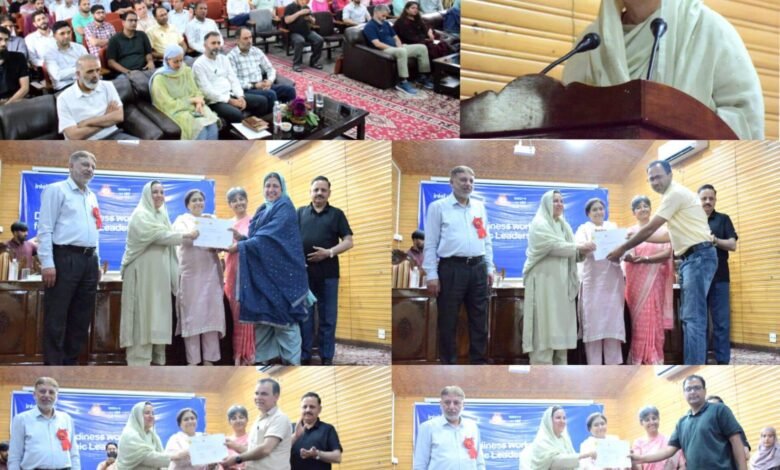
Certificates were also distributed among the participants in recognition of their successful completion of the two-day Digital Readiness Workshop.
The valedictory ceremony was attended by college principals, officers of the University administration, faculty members, academic leaders and other participants from the University and affiliated colleges.