CS for emulating national best practices for enhancing Ease of Doing Business in J&K Takes stock of practices adopted by Maharashtra & Gujarat

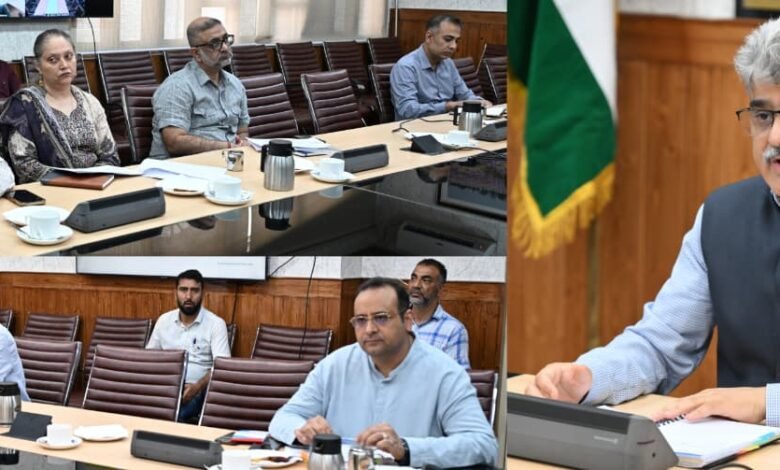
SRINAGAR, JULY 17: Chief Secretary, Atal Dulloo, today chaired a high-level meeting to review the best practices adopted by leading States in promoting Ease of Doing Business (EoDB) and Ease of Living, with a view to examining their suitability for implementation in Jammu & Kashmir.
The meeting was attended by various Administrative Secretaries and senior officers of the concerned departments.
At the outset, the Chief Secretary was given detailed presentations on the governance and regulatory reforms undertaken by the States of Maharashtra and Gujarat, highlighting their initiatives aimed at creating a business-friendly ecosystem through simplification of procedures, digital governance, regulatory reforms and citizen-centric service delivery.
The presentations outlined a wide range of initiatives adopted by the two States, including reduction in regulatory compliances, elimination of redundant procedures, end-to-end digitization of government services, strengthening of single-window systems, rationalization of inspections, decriminalization of minor regulatory offences, investor facilitation mechanisms, time-bound service delivery, simplification of land and construction-related approvals and adoption of technology-driven governance models.
The reforms implemented under the Business Reform Action Plan (BRAP), District BRAP, deregulation initiatives and Jan Vishwas framework were also highlighted during the meeting.
Reviewing the reforms presented during the meeting, the Chief Secretary observed that Jammu & Kashmir has already undertaken several governance reforms over the past few years and now needs to further accelerate the pace of administrative transformation by adopting proven national best practices suited to the Union Territory’s governance framework.
He stressed that reforms aimed at improving Ease of Living should complement economic reforms by ensuring hassle-free access to government services, minimizing procedural delays and enhancing public satisfaction.
The Chief Secretary emphasized that immediate focus should be laid on rationalization and whitelisting of services, further simplification of regulatory processes, decriminalization of minor offences and undertaking the necessary amendments in the relevant Acts, Rules and regulations to create a more enabling and investor-friendly ecosystem.
Addressing the officers, the Chief Secretary observed that sustained and well-directed reforms invariably translate into greater investor confidence and increased investments. He said that several States and UTs have emerged as frontrunners in governance reforms and service delivery, and Jammu & Kashmir should proactively emulate such proven best practices rather than reinventing the wheel.
He remarked that there are numerous success stories across the country that offer valuable learning opportunities for the UT. By adopting these tested models and adapting them to local requirements, J&K can accelerate its reform agenda while avoiding duplication of effort and ensuring faster outcomes.
He directed the Centre for Innovation, Transformation and Governance (CITaG) to undertake a comprehensive assessment of the reforms already implemented in the Union Territory vis-à-vis those adopted by leading States, and accordingly prepare a roadmap outlining the future course of action. He stressed that such an assessment should clearly identify the existing gaps and prioritize reforms that can be implemented in the days to come.
Underscoring the importance of adopting an investor-centric approach, the Chief Secretary said that all reforms must be viewed from the perspective of entrepreneurs and investors rather than from the standpoint of government departments. He maintained that governance systems should be designed to make compliance simpler, approvals faster and service delivery more efficient and transparent.
He further impressed upon CITaG to formulate a comprehensive, well-defined and time-bound action plan with clearly identifiable milestones and measurable outcomes for implementation of these reforms in Jammu & Kashmir. He also directed the organisation to maintain close coordination with the concerned authorities in Maharashtra and Gujarat to gain a deeper understanding of their reform processes, implementation strategies and institutional mechanisms so that the best practices can be effectively adapted to the needs of the Union Territory.
The meeting concluded with a consensus that the adoption of proven governance models from across the country, suitably customized to local requirements, would significantly strengthen institutional efficiency, enhance investor confidence and further the Government’s vision of achieving higher standards of Ease of Doing Business and Ease of Living in Jammu & Kashmir.