CM stresses need for comprehensive reforms to ensure a foolproof, transparent and merit-based examination system
Chairs meeting with members of High-Powered Task Force on Examination Reforms Govt to extend all possible support to Task Force to fulfil its mandate: CM; says credibility of examinations directly impacts future of youth

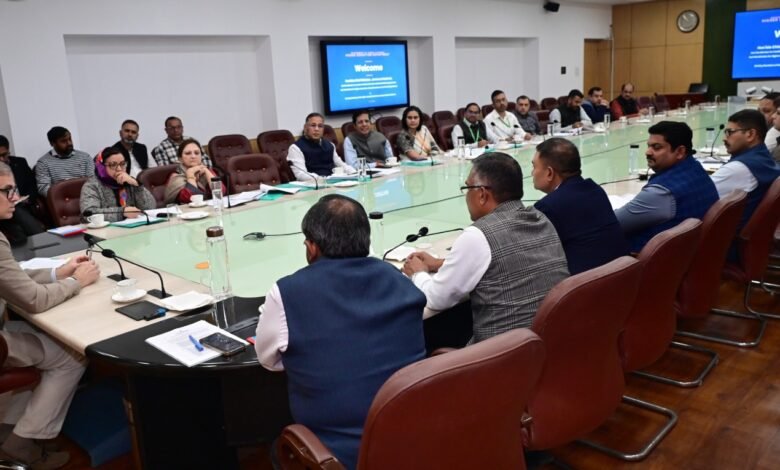
JAMMU, NOVEMBER 12: Chief Minister Omar Abdullah today called for comprehensive reforms in the examination system in Jammu and Kashmir. He stressed the need to make examinations secure, transparent, technology-driven and as foolproof as humanly possible to safeguard the future of students and ensure that merit remains the sole criterion for selection.
Chairing a meeting with members of the High-Powered Task Force (HPTF) on Examination Reforms at the Civil Secretariat here, the Chief Minister emphasised the importance of strengthening examination security, gradually transitioning towards computer-based testing, improving the credibility of board examinations and addressing concerns relating to the subjective component of selection processes.
The Chief Minister said that the need for robust examination reforms had become particularly evident following the cancellation of NEET-UG 2026 and the subsequent re-examination, which caused considerable inconvenience and additional stress to lakhs of aspirants across the country.
He noted that while examination irregularities under the traditionally decentralised system generally remained confined to particular regions, the transition towards centralised examinations had significantly widened their impact, with a paper leak potentially affecting candidates across the country.
Stressing the need to strengthen the examination ecosystem, Omar Abdullah said the Government would extend every possible support to the Task Force in fulfilling its mandate, as the credibility of examinations had a direct bearing on the future of young people.
The Chief Minister also underlined the importance of a gradual transition towards computer-based examinations, observing that students must be adequately familiarised with the technology before such a system is introduced on a wider scale.
Omar Abdullah also advocated examining the possibility of incorporating school board examination performance into the selection framework for competitive and entrance examinations.
He said such an approach could help reduce the excessive dependence on a single entrance examination while also restoring the importance of regular school education and board examinations.
The Chief Minister stressed that a suitable mechanism would have to be evolved to ensure a level playing field for students from different educational boards, including JKBOSE, CBSE and ICSE, so that candidates from any particular board were not placed at a disadvantage.
The Chief Minister also highlighted the need to strengthen transparency in the interview and viva-voce components of recruitment and admission processes.
Observing that concerns were frequently raised by candidates regarding the subjective nature of oral examinations and the possibility of manipulation of marks, he suggested that the Task Force could examine measures to make this component more objective, transparent and accountable.
He said the ultimate objective of all examination reforms must be to establish a genuinely merit-based system in which the most deserving candidates secure opportunities on the basis of their performance and ability.
At the outset, Commissioner Secretary, Higher Education Department, Ram Niwas Sharma, gave a detailed presentation on the examination reform initiatives undertaken by the Jammu and Kashmir Government and the arrangements put in place for the conduct of national-level examinations in J&K.
The meeting also discussed the mandate of the High-Powered Task Force constituted by the Government of India to recommend comprehensive reforms in examinations conducted by the National Testing Agency (NTA), including NEET-UG, JEE (Main), CUET-UG and UGC-NET.
The Task Force has been mandated to examine various aspects of the examination ecosystem, including examination design, security, institutional governance, use of emerging technologies such as Artificial Intelligence and Blockchain, inclusivity, student well-being and a time-bound roadmap for implementation of reforms.
The meeting reviewed the arrangements made by J&K administration for the conduct of NEET-UG 2026, including coordination among civil and police authorities, examination-centre preparedness, security of question papers, deployment of nodal officers and constitution of committees at UT, divisional and district levels.
The meeting also took stock of the security arrangements put in place for the transportation and custody of question papers, including police-escorted movement from designated banks, CCTV-monitored strong rooms, round-the-clock security, prescribed frisking procedures and monitoring of examination centres.
Besides, the members deliberated on examination reforms undertaken by the Jammu and Kashmir Public Service Commission (JKPSC), Jammu and Kashmir Services Selection Board (JKSSB), universities and other higher education institutions.
Best practices relating to question paper security, digital examinations, transparent evaluation, timely declaration of results and issuance of degrees were also discussed.
Various suggestions and recommendations were put forward by the participating Ministers and other officers, with particular emphasis on strengthening institutional safeguards, leveraging technology, eliminating examination malpractices and reducing avoidable stress for candidates.
The deliberations were aimed at evolving a comprehensive and practical framework that would make examinations more secure, credible, transparent and student-friendly, while ensuring equal opportunities and a level playing field for all aspirants.
The meeting was attended by Minister for Health and Medical Education Sakina Itoo; Minister for Education Shamim Firdous; Acting Chief Secretary Shailendra Kumar; Additional Chief Secretary to the Chief Minister Dheeraj Gupta; Additional Director General of Police, Armed; administrative secretaries of the General Administration, Health and Medical Education, and Higher Education Departments; Chairman, JKSSB; and members of the High-Powered Task Force, Tapan Kumar Deka and Prof. V. Kamakoti.
The visiting members were accompanied by Director National Recruitment Agency and other officials of the Task Force Secretariat.