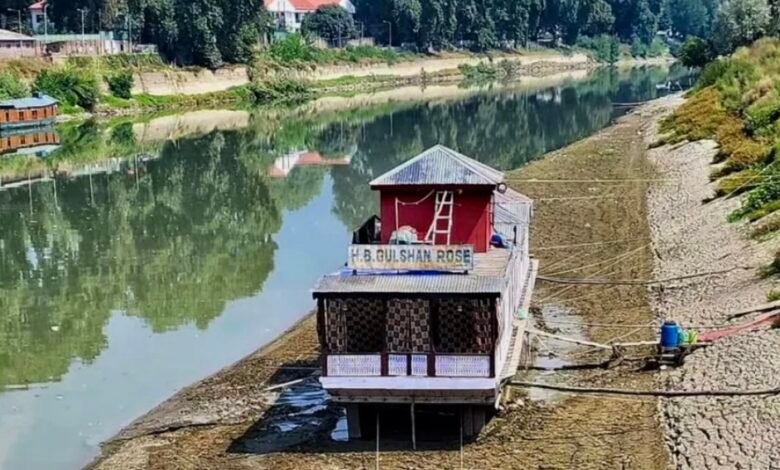
Srinagar, Dec 02: Kashmir’s water system is showing signs of severe stress as rivers, tributaries, and freshwater springs across the Valley continue to shrink. The Jhelum River, the lifeline of the region, has dropped below the reduced zero level at key monitoring stations, while streams sustaining irrigation, drinking water, and groundwater recharge are also running unusually low.
At the Sangam gauge station, the Jhelum’s water level fell to –0.53 feet, indicating extremely shallow flow. Downstream, the river stood near 3 feet at Ram Munshi Bagh and around 1 foot at Asham, reflecting a widespread decline in discharge.
Major tributaries, including Lidder Nallah, Rambiyara Nallah, Ferozpora Nallah, and the Pohru River, are also flowing well below normal levels, reducing water availability for drinking and agriculture across large parts of the Valley.
According to independent weather analyst Faizan Arif, Jammu and Kashmir recorded an 83 percent rainfall deficit in November, receiving just 6.1 mm of rainfall against the monthly average of 35.2 mm. All ten districts of the Kashmir Valley were classified under the “large deficient” rainfall category for the month.
The dry spell is expected to continue. Arif said no major weather changes are anticipated over the next ten days, though isolated snowfall may occur in higher reaches. Overall conditions are likely to remain dry across the region.
Long-term studies by the Wadia Institute of Himalayan Geology and ISRO indicate that over 18 percent of Himalayan glaciers in the region have retreated in recent decades. Reduced snowfall and persistent rainfall shortages have accelerated the depletion of springs and weakened catchment areas feeding rivers such as the Lidder and Pohru.
The impact is already visible on the ground, with several areas of Srinagar reporting significant reductions in municipal water supply.
Environmental experts warn that without immediate conservation measures and technical interventions, including artificial groundwater recharge, Kashmir may face prolonged drought-like conditions, further straining drinking water supplies, agriculture, and fragile Himalayan ecosystems.
“We are heading toward unprecedented hydrological stress,” said an environmental researcher at the University of Kashmir. “If winter snowfall fails again this year, Kashmir could face a water crisis far more serious than anything seen in the past decade.”