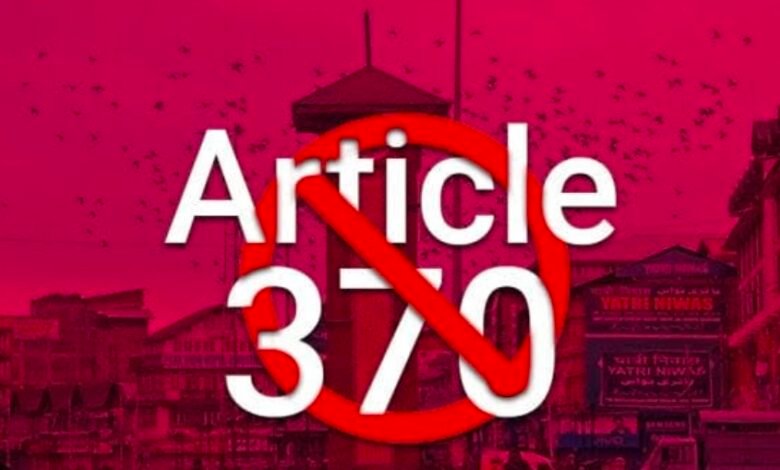
*The Quiet Change in Jammu and Kashmir* *Seven Years After Article 370, the Most Meaningful Transformation Is the Return of Ordinary Life*
Not every transformation announces itself through grand ceremonies. Some changes enter our lives quietly.

They can be seen in a shop remaining open until its usual closing time, in a student completing an academic session without prolonged disruption, in a family stepping out for an evening without first checking whether the situation is tense, and in a tourist making plans with confidence rather than uncertainty.
As Jammu and Kashmir completes seven years since the constitutional changes of August 5, 2019, there will be much discussion about Article 370. Political parties will interpret the anniversary according to their respective positions. Constitutional experts will examine its legal meaning, while administrators will present figures relating to infrastructure, investment and public welfare.
As someone who has lived in Jammu and Kashmir, I see the change through a simpler measure: the growing space available for ordinary life.
For a region that has spent decades under the shadow of violence, unrest and uncertainty, normality is not an insignificant achievement. It is the foundation upon which every other form of progress depends.
A road can be constructed in a disturbed region, but it will not deliver its full economic value if movement remains uncertain. A hotel can be built, but it cannot sustain livelihoods without tourists. A school can have modern classrooms, but education cannot flourish when the academic calendar is repeatedly interrupted. A young entrepreneur may possess ideas and ability, but a business requires stability, customers and confidence.
Peace, therefore, is not merely one achievement among many. It is the condition that makes all other achievements meaningful.
Those who have lived through earlier periods remember how uncertainty entered almost every aspect of life. Parents worried about children returning from school. Traders could not predict whether markets would remain open. Tourists cancelled bookings. Students lost valuable classroom time. Transport services were affected, examinations were postponed and daily-wage earners often suffered the most.
The economic cost was significant, but the emotional cost was perhaps even greater. People gradually learned to plan their lives around possible disruption.
The change visible today is that disruption no longer defines the daily routine in the same manner.
Official data indicate a substantial reduction in organised shutdowns and terrorist-initiated incidents. Organised strikes and shutdowns, recorded at 52 in 2018, fell to zero from 2023 through April 2026. Terrorist-initiated incidents declined from 228 in 2018 to 12 in 2025. These figures must be understood with seriousness and without triumphalism, because every act of violence and every lost life remains a tragedy. Nevertheless, the broader improvement in the security environment is real and has affected public life.
The most persuasive evidence of peace is not found in official statements. It is found in changed behaviour.
People remain outside later. Commercial areas are busier. Public events attract families. Students participate in competitions, cultural programmes and sporting activities. Hotels, restaurants and transport operators plan for expanding demand. Destinations once considered difficult or unfamiliar are entering tourist itineraries.
This confidence cannot be manufactured through publicity. Visitors travel when they believe a destination is welcoming and reasonably secure. Businesses invest when they believe activity can continue. Families venture into public spaces when fear no longer dominates every decision.
Jammu and Kashmir recorded more than 2.3 crore tourist visits in 2024, according to official figures. Tourism statistics are often presented as evidence of economic growth, but they also tell a deeper story. Every visitor represents a decision made in favour of confidence.
The benefits extend far beyond hotels and major tourism companies. A taxi driver gets more work. A family running a homestay earns an income. A craftsperson finds new customers. A photographer, guide, pony owner, restaurant worker or roadside vendor gains an opportunity.
This is how peace reaches the household economy.
Peace has also allowed development to become more visible. Projects that once existed mainly on paper can now be experienced in everyday travel and public services. Roads, tunnels, railway links, hospitals, educational institutions and digital platforms are gradually changing how residents connect with opportunities.
But the importance of these projects should not be reduced to their size or cost. Their real value lies in the confidence they create.
A tunnel is important because it reduces uncertainty during difficult weather. A railway line is important because it connects families, markets and educational opportunities. A hospital is important because it may prevent a patient from undertaking an exhausting journey outside the region. A digital service matters because it saves a citizen from making repeated visits to an office.
Development becomes human only when it improves the predictability and dignity of daily life.
There has also been a gradual economic improvement. Jammu and Kashmir’s per-capita income relative to the national average increased from 71.9 per cent in 2014-15 to approximately 76.5 per cent in 2025-26. This does not mean that economic concerns have disappeared or that progress has reached every household equally. It does, however, indicate a movement towards greater convergence with the national economy.
For young people, the most important outcome of a peaceful environment is the freedom to think beyond survival and disruption.
A generation that grows up amid instability often learns to lower its expectations. It becomes accustomed to cancelled plans, uncertain opportunities and the belief that a successful future must necessarily be built somewhere else.
That mindset is beginning to change.
Young residents are entering entrepreneurship, tourism, technology, sports, creative industries, civil services and new forms of digital work. They are opening cafés, launching local brands, producing online content, promoting unexplored destinations and seeking markets beyond the region.
Not every venture will succeed. Employment remains a serious concern, and the private economy must expand further. Yet there is a difference between a young person facing economic competition in a peaceful environment and one attempting to build a future amid continuous instability.
Peace does not guarantee success, but it makes effort worthwhile.
This transformation must not be described as complete. Jammu and Kashmir continues to face security threats, including cross-border terrorism. The suffering caused by attacks on civilians, pilgrims and security personnel reminds us that peace remains precious and vulnerable. It must never be taken for granted.
Nor should the language of progress make us insensitive to families who have experienced loss.
Peace is not served by denying pain. It is strengthened when society refuses to allow violence to determine its future.
The coming years must therefore focus on consolidating what has been achieved. Development must reach remote villages and border communities. Young people need wider employment opportunities. Tourism must expand without damaging fragile ecosystems. Cities need better planning, while completed infrastructure must be properly maintained.
Most importantly, every region and community must feel that it has a meaningful place in the future of Jammu and Kashmir.
Seven years after the abrogation of Article 370, the most encouraging change is that public conversation is increasingly moving towards the future. People discuss jobs, education, business, tourism, infrastructure, sports and connectivity. They may disagree on politics, as citizens in every democracy do, but disagreement no longer needs to become disruption.
This is the essence of normal democratic life.
History will continue to debate the constitutional decision of August 5, 2019. But ordinary residents will assess this period through lived experience. They will ask whether their children attended school regularly, whether businesses found customers, whether travel became easier, whether public spaces became safer and whether families gained the confidence to plan ahead.
For me, the transformation of Jammu and Kashmir is best represented not by a statistic or a building, but by a simple scene: people going about their lives without treating peace as an unusual event.
The return of the ordinary may appear modest from a distance.
For Jammu and Kashmir, it is extraordinary.
*The author is a technology professional, geopolitical analyst, newspaper columnist and author based in Jammu. He can be reached on bharatnanda.author@gmail.com and x.com/bharatnanada_*