CS assesses Mission YUVA progress during Apex Committee review meeting Disbursement of over ₹1,100 Cr and sanctioning of 25,000 cases achieved under the mission

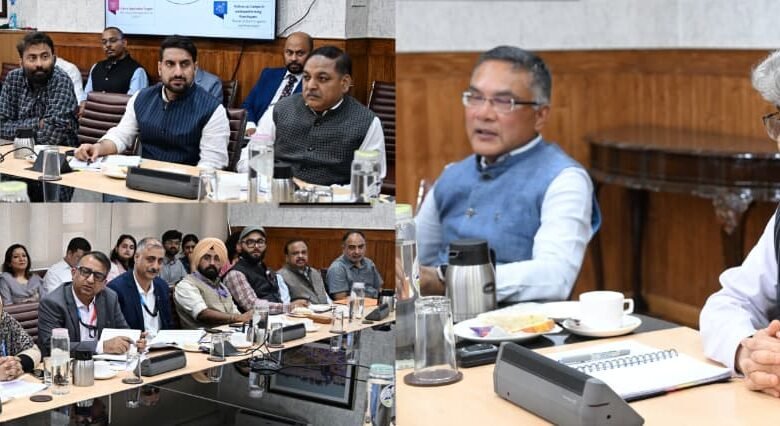
SRINAGAR, MAY 18: Chief Secretary, Atal Dulloo today chaired the Apex Committee Meeting of Mission YUVA and reviewed the progress achieved under the ambitious initiative aimed at fostering entrepreneurship, generating employment and establishing Jammu & Kashmir as a thriving hub of enterprises and sustainable livelihoods.
The meeting was attended by senior officers from different departments including ACS, Finance; Commissioner Secretary, School Education; Secretary, Labour & Employment; Secretary, RDD; Director, Employment; Executive Director, EDI representatives from J&K Bank and other financial institutions, district administrations and other stakeholders associated with implementation of Mission YUVA.
During the meeting, the Chief Secretary took a comprehensive review of the performance recorded under the four foundational pillars of Mission YUVA constituting the creation of Culture, Capital, Capacity and enhancing Connectivity for the ease and welfare of the applicants.
Besides this the Chief Secretary assessed district-wise achievements, institutional preparedness, credit facilitation, entrepreneurship development and implementation bottlenecks. He emphasized the need for coordinated efforts by the departments, financial institutions and district administrations to ensure that Mission YUVA evolves into a transformative movement for youth empowerment and economic growth across the Union Territory.
During the review, special attention was given to pendency at different stages of application processing. The Chief Secretary directed district administrations, SBDUs and banking institutions to expedite clearance of pending cases and strictly adhere to timelines prescribed under the scheme. He stressed on time-bound verification of applications, DLIC approvals and loan sanctioning to maintain the momentum achieved under the mission.
The Chief Secretary also reviewed progress achieved under the capacity-building component of the mission. It was informed that more than 21,000 applicants had completed hybrid-mode entrepreneurship training, while over 300 training centres and more than 200 trainers had been activated across the UT. Plans are also underway for collaboration with JKEDI to strengthen entrepreneurship and management training for Mission YUVA applicants.
The Chief Secretary underscored the importance of outcome-based monitoring and directed all Deputy Commissioners to focus on improving application conversion, training completion, market linkage and enterprise sustainability.
He reiterated that Mission YUVA should not merely remain a financial assistance programme but must evolve into a comprehensive ecosystem capable of nurturing entrepreneurship culture and creating long-term livelihood opportunities for the youth of Jammu and Kashmir.
The Secretary, L&E, Kumar Rajeev Ranjan took this occasion to apprise the meeting that Mission YUVA envisions creation of employment opportunities through nano enterprises, new MSMEs, business acceleration initiatives and neo-innovative enterprises.
He added that the programme seeks to build an entrepreneurship ecosystem through targeted interventions in awareness generation, credit enablement, capacity building, market linkages and business support mechanisms.
The meeting especially reviewed the status of credit facilitation under Mission YUVA. The Secretary informed that over 1.07 lakh applications had been received so far, out of which more than 57,000 applications had been approved by District Level Implementation Committees (DLICs). Banks have sanctioned loans in more than 25,000 cases involving credit support exceeding ₹1,200 Cr, while loan disbursement of around ₹1,119 Cr had already been achieved in over 21,000 cases.
The meeting was informed that Mission YUVA has set an ambitious target of establishing 50,000 enterprises during 2026-27, including 44,000 nano enterprises, 4,000 new MSMEs and 2,000 existing MSMEs to be supported for expansion. District-wise targets and performance indicators were also reviewed in detail.
Reviewing the progress under the Information, Education and Communication (IEC) component, the Chief Secretary was apprised that Udyam Jagriti 4.0 campaign during 2025-26 achieved outreach to nearly 3.4 lakh citizens, while more than 5.3 lakh individuals had been covered cumulatively through various awareness campaigns.
It was given out that the campaign covered students, SHG women, certified trainees and existing MSMEs across Jammu and Kashmir. Further it was divulged that more than 2.5 lakh app downloads had also been recorded, while awareness drives covered almost all blocks and a majority of Panchayats across the UT.
The meeting was further informed by the Director Employment, Harvinder Singh that Udyam Jagriti 5.0 for the year 2026-27 is going lay focus on targeted mobilization among college students, SHG women, trained youth and existing MSMEs with a special emphasis on converting awareness into enterprise creation and credit linkage.
Under the proposed interventions, he gave out that the department is also planning conducting hackathons, entrepreneurship competitions, innovation support systems and application facilitation camps are planned to be organized at institutional and Panchayat levels.
While reviewing institutional strengthening measures, the Chief Secretary was informed that substantial progress had been achieved in recruitment and empanelment under the Institutional Business Support Mechanism (IBSM). More than 900 motivators, over 100 SBDU personnel and a large number of BHD members had already been engaged across districts to provide on-ground support, handholding and enterprise facilitation to aspiring entrepreneurs.
On the connectivity and market linkage front, the meeting was informed that significant progress had been achieved in onboarding stores and products on the Mission YUVA Seller App and ONDC-linked platforms to facilitate digital market access for local entrepreneurs. District dashboards and monitoring systems have also been operationalized to strengthen performance tracking and outreach.
The meeting also discussed several key policy interventions and operational reforms aimed at improving mentorship support, strengthening institutional outreach and enhancing the efficiency of enterprise facilitation systems across the districts here.