Lieutenant Governor Addressed “Seva Se Samriddhi- Panchayat-led Service Delivery” Regional Workshop organised by Union Ministry of Panchayati Raj and J&K Administration

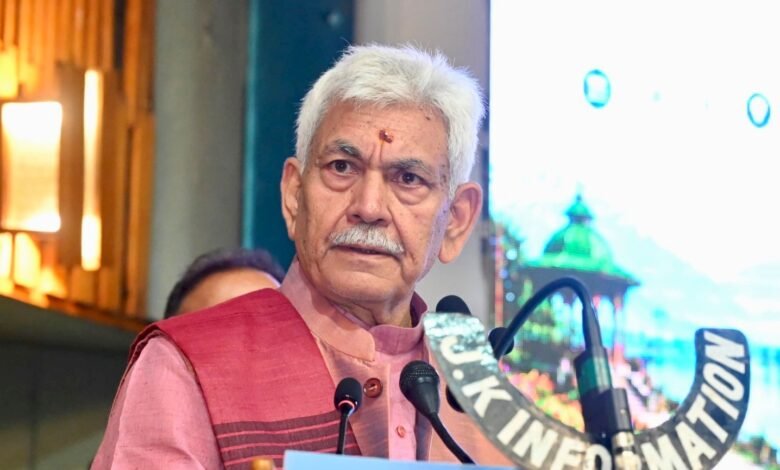
Lieutenant Governor highlighted historic transformations under Hon’ble Prime Minister Shri Narendra Modi and the inclusive development revolution that was driven by the 3-tier Panchayati Raj system
In 2020, we set out to build a J&K where government reaches the citizen’s doorstep. With a ‘People First’ approach, we revolutionized public service delivery. From just 35 online services in 2020 to more than 1,100 by 2023, UT topped the national e-service delivery rankings: LG Sinha
We made Panchayati Raj institutions the strongest voice and largest participants in governance. Through ‘Block Diwas’ and ‘Back to Village’ campaigns, we tried to ensure services reach doorsteps, infrastructure meets local needs, and policies flow from the grassroots up: LG
We put the common person’s aspirations at the core of administration. By ensuring accountability and citizen participation, we have translated a commitment to multi-generational change into reality within 3 years and rebuilt a powerful relationship of trust with citizens: LG Sinha
SRINAGAR, JUNE 23: The Lieutenant Governor, Shri Manoj Sinha today addressed “Seva Se Samriddhi- Panchayat-led Service Delivery” Regional Workshop organised by Union Ministry of Panchayati Raj and J&K Administration. The Lieutenant Governor highlighted historic transformations under Hon’ble Prime Minister Shri Narendra Modi and the inclusive development revolution that was driven by the 3-tier Panchayati Raj system.
“In 2020, we set out to build a J&K where government reaches the citizen’s doorstep. With a ‘People First’ approach, we revolutionized public service delivery. From just 35 online services in 2020 to more than 1,100 by 2023, UT topped the national e-service delivery rankings.
We made Panchayati Raj institutions the strongest voice and largest participants in governance. Through ‘Block Diwas’ and ‘Back to Village’ campaigns, we tried to ensure services reach doorsteps, infrastructure meets local needs, and policies flow from the grassroots up.
We put the common person’s aspirations at the core of administration. By ensuring accountability and citizen participation, we have translated a commitment to multi-generational change into reality within 3 years and rebuilt a powerful relationship of trust with citizens,” the Lieutenant Governor said.
The Lieutenant Governor urged the participants from Haryana, Jharkhand, Karnataka, Himachal Pradesh, Uttar Pradesh and Uttarakhand to study the grassroots service delivery models of Jammu Kashmir including BEAMS-EMPOWERMENT, Aapki Zameen-Aapki Nigrani and “Your Mobile -Our Office” which had transformed service delivery and program implementation in villages. He highlighted the Government of India report which had observed that between 2016 and 2018 Jammu Kashmir recorded 20 million digital transactions over three years. In contrast, in the first six months of 2023 alone there were 50 Crore digital transactions – far exceeding many large states such as Maharashtra, Tamil Nadu, Punjab, Odisha, Karnataka, and Kerala.
“More than 15,000 CSC (Common Service Centre) outlets are operational in Jammu Kashmir today. Of the 4,290 panchayats, 4,211 are connected to this network, representing an impressive 98.16 percent coverage. The remaining 79 panchayats are in very remote and border areas where connectivity remains a challenge.
We must also strengthen a culture of knowledge exchange. It is essential to share successful models, best practices, and innovations from each state and Union Territory so that service delivery at the last mile becomes more effective. I believe events like this will foster mutual learning and cooperation. A successful panchayat model in Haryana can inspire a panchayat in Karnataka. Similarly, an innovative initiative from Jammu Kashmir can open new possibilities in Jharkhand,” the Lieutenant Governor said.
The Lieutenant Governor said that the regional conference on service delivery is a reflection of three core traits of India- unity in diversity, strength through cooperation, and prosperity through service.
“I am confident these qualities together will build local governance rooted in collaboration, participation, and a spirit of change. Our objective must be clear: to develop panchayats where every citizen can access services digitally, grievances are resolved quickly, decisions are taken collectively, and accountability is systemic. We must remember that the panchayat of the future will not be merely an administrative unit. They will be a dynamic centre of innovation, equal opportunity, sustainable development, and public trust,” he said.
The Lieutenant Governor shared key recommendations with the participants to implement in their respective states. The focus remains on strengthening grassroots service delivery and driving innovation across the nation.
“My first recommendation is to establish a “Village Innovation Lab” in every panchayat. Local youth, Krishi Vigyan Kendras, and social organisations can collaborate there on low-cost solar solutions, new irrigation techniques, and other local innovations. My second recommendation is to run modern capacity-building programmes in every panchayat so leaders grow confident and capable of building self-reliant, progressive villages. My third recommendation is to institutionalise participatory budgeting in every panchayat- an initiative we had launched in Jammu Kashmir in 2021. When citizens decide how part of the panchayat fund is spent, governance becomes a powerful means of citizen participation.
My fourth recommendation is to mainstream sustainable development models like Green Jammu Kashmir, Ek Ped Maa Ke Naam, Ek Ped Beti Ke Naam, across panchayats nationwide. My fifth recommendation is to put women in leadership roles across all schemes. In Jammu Kashmir we prioritised women’s leadership in campaigns against substance abuse and in ensuring access to clean drinking water, dairy, health, education, and social equity,” the Lieutenant Governor said.
As part of the workshop, Panditpora Gram Panchayat from Kupwara and Shri Syed Waris Hafiz, a dedicated CSC Village Level Entrepreneur from Budgam, J&K UT, along with outstanding Gram Panchayats and Common Service Centres (CSCs) from participating states were recognized and felicitated.
The workshop, held in collaboration with the Common Services Centre Special Purpose Vehicle (CSC-SPV), Ministry of Electronics and Information Technology and Department of Rural Development and Panchayati Raj, J&K, forms part of a sustained series of initiatives undertaken by the Ministry to facilitate improved service delivery and strengthen Ease of Living in Grameen Bharat through empowered, accountable, and responsive Panchayati Raj Institutions and Rural Local Bodies.
Representatives from civil society organisations, academic and research institutions, and organisations working in rural technology and digital public infrastructure also participated, contributing diverse perspectives on last-mile governance and service delivery.
Deliberations focused on strengthening Panchayat-led service delivery through digital transformation, citizen participation, innovation, and improved accessibility of public services at the grassroots. Panel discussions, technical sessions, and experience-sharing sessions provided a structured platform for inter-State knowledge exchange and the dissemination of scalable governance models.
Shri Javid Ahmad Dar, Minister for Rural Development & Panchayati Raj, J&K; Shri Vivek Bharadwaj, Secretary, Ministry of Panchayati Raj; Shri Saurabh Bhagat, Commissioner Secretary, Information Technology, J&K; Ms. Palka Sahni, Joint Secretary, MoPR; Shri Pravin Chandekar, Chief Operating Officer, Common Service Centres; Ms. Rehana Batul, Director General, J&K IMPARD; Shri Mohammad Aijaz Asad, Secretary, Rural Development and Panchayati Raj, J&K; Shri Rajiv Omprakashn, DIG CKR; Dr. GV Sundeep Chakravarthy, SSP Srinagar; Shri Akshay Labroo, Deputy Commissioner Srinagar; Ms Anoo Malhotra, DG Rural Sanitation J&K; Panchayat functionaries, elected representatives, Village Level Entrepreneurs (VLEs), and senior officials attended the inaugural session.