J&K eyes revenue from Green Projects through Carbon Credits CS reviews the framework; calls for comprehensive policy, capacity building and digital monitoring platform

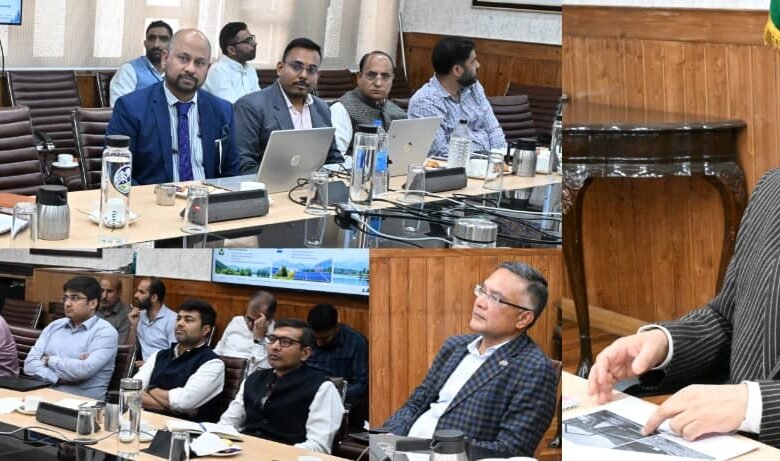
SRINAGAR, SEPTEMBER 25: Chief Secretary, Atal Dulloo, today chaired ameeting to review the proposed Carbon CreditFramework for Jammu and Kashmir, aimed at unlocking the economic potential of the Union Territory’s ecological assets and creating sustainable revenue streams through carbon markets and green financing.
The meeting besides ACS, Finance was attended by Commissioner Secretary, Science & Technology; MD, JKPDC; Commissioner, JMC/SMC; DG, Resources; DG, A&T; DG, Budget; CEO, CITaG concerned officers and technical experts from CITaG.
The framework, presented by the Centre for Innovation and Transformation in Governance (CITaG) in collaboration with the Finance Department, envisages a comprehensive strategy built around four key pillarsconstitutingCarbon Markets, Green Cess, Convergence and a dedicated Green Fund.
Appreciating the preliminary work undertaken by CITaG, the Chief Secretary called for developing a comprehensive policy document supported by a well-defined Standard Operating Procedure (SOP) to ensure seamless implementation across the Union Territory.
He directed CITaG to organise a specialised capacity-building workshop for all concerned departments to familiarise officers with carbon accounting, data standards and their respective implementation responsibilities.
Emphasising technology-driven monitoring and transparency, the Chief Secretary suggested exploring collaboration with the Bhaskaracharya National Institute for Space Applications and Geo-informatics (BISAG-N) for developing an integrated digital monitoring platform and carbon registry.
During the deliberations, Additional Chief Secretary, Finance, Shailendra Kumar, highlighted the immense potential of J&K’s agriculture, hydropower and forestry sectors in generating carbon credits and attracting green investments.
He asked CITaG to prioritise these sectors while also incorporating emerging opportunities arising from rooftop solar installations under PM Surya Ghar Yojana and the growing adoption of electric vehicles across the Union Territory.
The ACS Finance also advocated the early establishment of a dedicated Green Fund to pool carbon proceeds and green revenues, safeguard their utilisation and leverage these resources for financing future climate-resilient development initiatives.
Earlier, the presentation by CITaG highlighted the considerable untapped potential of J&K’s ecological assets, observing that the Union Territory has yet to generate revenue from global carbon markets despite substantial investments in environmentally sustainable activities.
Citing successful initiatives elsewhere, the meeting was informed that BMC has earned ₹27 crore, Gujarat ₹22 crore, Indore Municipal Corporation ₹8.34 crore and Himachal Pradesh ₹20 crore through carbon credit monetisation and similar initiatives.
The proposed framework envisages integrating carbon screening into existing development programmes, including CAMPA, MGNREGS and the Holistic Agriculture Development Programme (HADP), to maximise environmental and financial returns while avoiding duplication of expenditure.
The meeting also deliberated on a proposed revenue-sharing mechanism under which 35 percent of net carbon proceeds would accrue directly to primary growers or community project owners, 30 percent to the J&K Green Fund, 15 percent to Farmer Producer Organisations (FPOs) and aggregators, and 10 percent each to district-level climate initiatives and sector-specific sustainability accounts.
Another key proposal discussed was the introduction of a Green Tourism Contribution to mobilise resources for climate resilience and environmental conservation at major tourist destinations.
The meeting also considered a 180-day implementation roadmap involving a comprehensive inventory of green assets, identification and execution of five to seven priority pilot projects across Jammu and Srinagar Municipal Corporations, agriculture and forestry sectors, and establishment of a secure digital repository for project-related data.
The proposed initiatives are intended to establish a sustainable institutional and financial mechanism for translating J&K’s environmental assets and climate-positive investments into measurable economic benefits for local communities and the Union Territory.