𝟳𝘁𝗵 𝗖𝗼𝗻𝘀𝗲𝗰𝘂𝘁𝗶𝘃𝗲 𝗪𝗶𝗻𝘁𝗲𝗿 𝗥𝗮𝗶𝗻𝗳𝗮𝗹𝗹 𝗗𝗲𝗳𝗶𝗰𝗶𝘁 𝗶𝗻 𝗝&𝗞 — 𝗪𝗶𝗻𝘁𝗲𝗿 𝟮𝟬𝟮𝟱–𝟮𝟲 𝗘𝗻𝗱𝘀 𝟲𝟱% 𝗕𝗲𝗹𝗼𝘄 𝗡𝗼𝗿𝗺𝗮𝗹; 𝗙𝗲𝗯𝗿𝘂𝗮𝗿𝘆 𝗖𝗼𝗹𝗹𝗮𝗽𝘀𝗲 𝗣𝘂𝘀𝗵𝗲𝘀 𝗦𝗲𝗮𝘀𝗼𝗻 𝘁𝗼 𝗢𝗻𝗲 𝗼𝗳 𝘁𝗵𝗲 𝗗𝗿𝗶𝗲𝘀𝘁 𝗼𝗻 𝗥𝗲𝗰𝗼𝗿𝗱

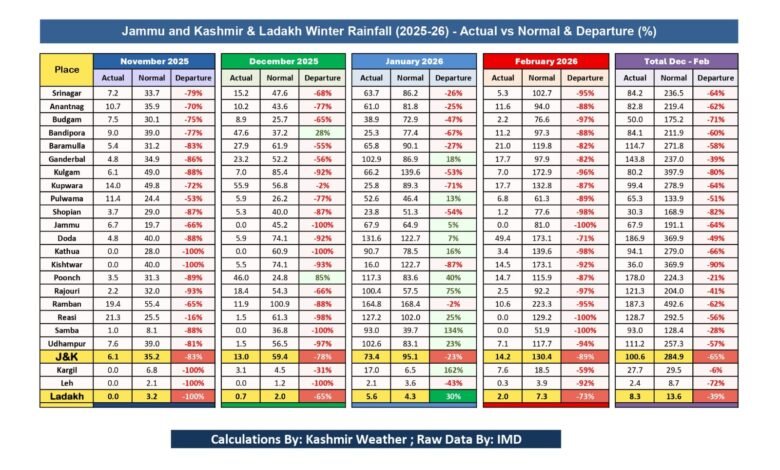
Jammu & Kashmir has recorded its seventh straight winter rainfall deficit, with the core winter period December 2025 to February 2026 ending at a massive –65% departure from normal.
The region received just 100.6 mm of precipitation against a normal of 284.9 mm during Dec–Feb 2025–26.
𝗠𝗼𝗻𝘁𝗵-𝗪𝗶𝘀𝗲 𝗕𝗿𝗲𝗮𝗸𝗱𝗼𝘄𝗻 (𝗗𝗲𝗰 𝟮𝟬𝟮𝟱 – 𝗙𝗲𝗯 𝟮𝟬𝟮𝟲)
𝐃𝐞𝐜𝐞𝐦𝐛𝐞𝐫 𝟐𝟎𝟐𝟓
● Actual: 13.0 mm
● Normal: 59.4 mm
● Departure: –78%
𝐉𝐚𝐧𝐮𝐚𝐫𝐲 𝟐𝟎𝟐𝟔
● Actual: 73.4 mm
● Normal: 95.1 mm
● Departure: –23%
January saw some Western Disturbance activity, preventing a total seasonal collapse. However, rainfall still remained below normal and could not compensate for December’s shortfall.
𝐅𝐞𝐛𝐫𝐮𝐚𝐫𝐲 𝟐𝟎𝟐𝟔
● Actual: 14.2 mm
● Normal: 130.4 mm
● Departure: –89%
February turned disastrous. With nearly 90% deficit, it was one of the driest Februarys in recent record. This sharp collapse dragged the entire winter seasonal total down to –65%.
𝗛𝗼𝘄 𝟮𝟬𝟮𝟱–𝟮𝟲 𝗖𝗼𝗺𝗽𝗮𝗿𝗲𝘀 𝗪𝗶𝘁𝗵 𝗣𝗿𝗲𝘃𝗶𝗼𝘂𝘀 𝗪𝗶𝗻𝘁𝗲𝗿𝘀 (𝗗𝗲𝗰–𝗙𝗲𝗯)
Winter — Departure
2019-20 – (minus) 20%
2020-21 — (minus) 37%
2021-22 — (minus) 8%
2022-23 — (minus) 34%
2023-24 — (minus) 54%
2024-25 — (minus) 45%
2025- 26 — (minus) 65%
The data confirms that every winter since 2019–20 has ended below normal, making this the 7th consecutive deficient winter season in J&K.
Looking at the past data:
● 2016–17 was a surplus winter (+29%)
● 2018–19 was also above normal (+36%)
● 2012–13 recorded +14%
However, post 2019 the pattern has clearly shifted toward persistent deficit conditions.
The only winter close to normal in recent years was 2021–22 (-8%).
This highlights a sharp drying trend in core winter precipitation.
𝗛𝘆𝗱𝗿𝗼𝗹𝗼𝗴𝗶𝗰𝗮𝗹 & 𝗘𝗻𝘃𝗶𝗿𝗼𝗻𝗺𝗲𝗻𝘁𝗮𝗹 𝗜𝗺𝗽𝗹𝗶𝗰𝗮𝘁𝗶𝗼𝗻𝘀
Winter precipitation in J&K is critical because:
● Snow accumulation in higher reaches feeds rivers and springs.
● It recharges groundwater systems.
● It sustains irrigation for orchards and crops.
● It regulates early-season temperatures via snow albedo.
With December almost dry, January subpar, February collapsing nearly 90% below normal, the snowpack generation window has weakened substantially.
Such back-to-back winter deficits reduce the natural meltwater buffer that Kashmir traditionally depends on during late spring, summer and autumn.
⚠️ 𝗘𝗺𝗲𝗿𝗴𝗶𝗻𝗴 𝗣𝗮𝘁𝘁𝗲𝗿𝗻, 𝗡𝗼𝘁 𝗮𝗻 𝗜𝘀𝗼𝗹𝗮𝘁𝗲𝗱 𝗘𝘃𝗲𝗻𝘁
Seven consecutive deficient winters indicate that this is not random variability alone but a sustained shift in seasonal precipitation behavior.
The repeated winter shortfalls since 2019–20 suggest:
● Increasing variability in Western Disturbance strength and frequency.
● Greater intra-seasonal concentration of rainfall events.
● Longer dry spells between active phases.
𝗗𝗶𝘀𝘁𝗿𝗶𝗰𝘁-𝗪𝗶𝘀𝗲 𝗗𝗲𝗰–𝗙𝗲𝗯 𝟮𝟬𝟮𝟱–𝟮𝟲 𝗥𝗮𝗶𝗻𝗳𝗮𝗹𝗹 𝗗𝗲𝗳𝗶𝗰𝗶𝘁
𝐊𝐚𝐬𝐡𝐦𝐢𝐫 𝐃𝐢𝐯𝐢𝐬𝐢𝐨𝐧
● Srinagar: 84.2 mm vs 236.5 mm normal (–64%)
● Anantnag: 82.8 mm vs 219.4 mm (–62%)
● Budgam: 50.0 mm vs 175.2 mm (–71%)
● Bandipora: 84.1 mm vs 211.9 mm (–60%)
● Baramulla: 114.7 mm vs 271.8 mm (–58%)
● Ganderbal: 143.8 mm vs 237.0 mm (–39%)
● Kulgam: 80.2 mm vs 397.9 mm (–80%)
● Kupwara: 99.4 mm vs 278.9 mm (–64%)
● Pulwama: 65.3 mm vs 133.9 mm (–51%)
● Shopian: 30.3 mm vs 168.9 mm (–82%)
𝐉𝐚𝐦𝐦𝐮 𝐃𝐢𝐯𝐢𝐬𝐢𝐨𝐧
● Jammu: 67.9 mm vs 191.1 mm (–64%)
● Doda: 186.9 mm vs 369.9 mm (–49%)
● Kathua: 94.1 mm vs 279.0 mm (–66%)
● Kishtwar: 36.0 mm vs 369.9 mm (–90%)
● Poonch: 178.0 mm vs 224.3 mm (–21%)
● Rajouri: 121.3 mm vs 204.0 mm (–41%)
● Ramban: 187.3 mm vs 492.6 mm (–62%)
● Reasi: 128.7 mm vs 292.5 mm (–56%)
● Samba: 93.0 mm vs 128.4 mm (–28%)
● Udhampur: 111.2 mm vs 257.3 mm (–57%)
𝗥𝗲𝗽𝗼𝗿𝘁 𝗕𝘆: 𝗞𝗮𝘀𝗵𝗺𝗶𝗿 𝗪𝗲𝗮𝘁𝗵𝗲𝗿