CS reviews progress in solarisation of Government buildings Seeks Action Plan for Renewable Energy Growth

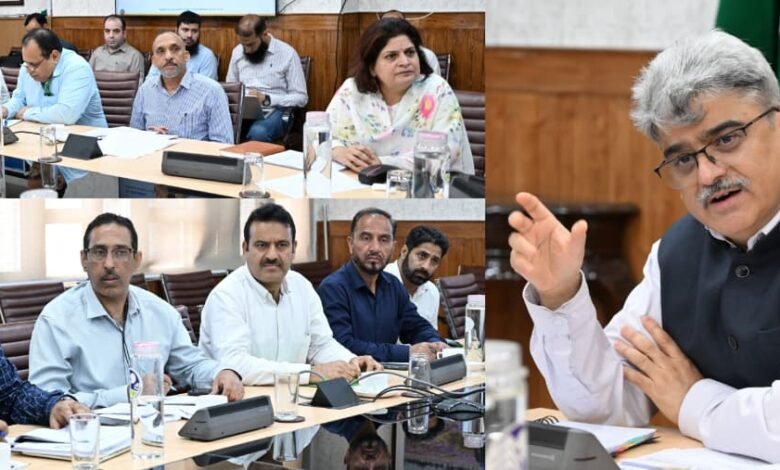
SRINAGAR, JUNE 01: Chief Secretary, Atal Dulloo, today chaired a review meeting of the Science & Technology Department to assess the initiatives undertaken for promotion of clean energy and the progress achieved in solarisation of government buildings across Jammu and Kashmir.
The meeting was attended by Commissioner Secretary, Science & Technology; Chief Executive Officer, JAKEDA; Director, Jammu and Kashmir Science, Technology and Innovation Council (JKSTIC); and other senior officers of the department.
During the meeting, the Chief Secretary undertook a comprehensive review of the solarisation programme being implemented across government establishments and emphasized the need for close coordination among the Science & Technology Department, Power Development Department (PDD) and district administrations to ensure smooth and timely installation of smart meters. He observed that effective metering is essential for realizing the full benefits of solar energy generation and optimizing energy savings.
Dulloo further directed the department to extend necessary assistance to government departments in finalizing Power Purchase Agreements (PPAs), enabling efficient utilization and management of the energy generated through solar installations.
He remarked that large-scale solarisation, coupled with the development of small and medium hydropower projects, has the potential to transform the energy landscape of Jammu and Kashmir, given the immense renewable energy potential available across the Union Territory.
Highlighting the need for inclusive and sustainable energy solutions, the Chief Secretary called for exploring alternative cooking energy options for people residing in remote and far-flung areas who continue to depend on conventional fuel sources. He also stressed the importance of expediting efforts towards formulation and implementation of the Renewable Energy (RE) Policy and promotion of Compressed Biogas (CBG) initiatives in Jammu and Kashmir.
Reviewing the functioning of the Jammu and Kashmir Science, Technology and Innovation Council (JKSTIC), the Chief Secretary urged the council to devise a focused and actionable strategy in collaboration with institutions such as the Islamic University of Science and Technology (IUST) for promoting food processing, skill development and other innovation-driven entrepreneurial ventures. He emphasized that stronger linkages between academic institutions and government agencies can play a significant role in fostering innovation-led economic growth and employment generation in the region.
Giving an overview of the department’s activities, the Commissioner Secretary, S&T, Babila Rakwal informed the meeting that JAKEDA is spearheading a range of initiatives including solarisation of government buildings, solar-powered agriculture pumps under PM-KUSUM, establishment of model solar villages, development of solar parks, promotion of rooftop solar systems, decentralized renewable energy devices and small hydroelectric projects across the Union Territory.
She further divulged that significant progress has been achieved under the flagship programme for solarisation of government buildings. Under the CAPEX mode, rooftop solar projects covering around 8,000 government buildings with a target capacity of 70 MW are being implemented, while another 175 MW capacity is being developed under the RESCO model adding that 3,000 government buildings have already been solarised and work is progressing rapidly on the remaining identified structures.
Reviewing the achievements recorded during the previous financial year, the CEO, JAKEDA, PN Dhar informed that over 2,200 solar agriculture pumps were installed, nearly 9,000 solar home lighting systems distributed in remote and tribal areas, 140 solar high mast lights established, around 8,000 solar street lights installed and more than 16,000 biomass cook stoves provided to households in underserved regions. These interventions have substantially improved access to clean energy while reducing dependence on conventional fuels.
The meeting further noted that under the PM-KUSUM scheme, 4,841 solar agriculture pumps have been installed and made operational against 5,000 sanctioned pumps, registering a completion rate of about 99 percent. The initiative is helping farmers reduce diesel consumption and lower irrigation costs while ensuring reliable access to water for agriculture.
The Chief Secretary also reviewed the progress on the Model Solar Village programme under which one village in each district has been identified for development as a renewable energy model. On the hydro power front, the meeting was informed that seven small hydroelectric projects with a cumulative capacity of 35.25 MW have already been commissioned in the Union Territory.
Additionally, a robust pipeline of hydro projects is under various stages of allotment, development and execution, with over 115 MW capacity expected to be added in the coming years.
The department also apprised the Chief Secretary about proposals for establishment of solar parks at identified locations in Jammu, development of a pilot solar-wind hybrid power project, installation of solar-powered electric vehicle charging stations and a proposed 100 MW Solar Power Park coupled with a 20 MW Battery Energy Storage System (BESS), which would be the first project of its kind in Jammu & Kashmir.