*Only peace, compassion can resolve unrest: Amit Shah in Ladakh*
*Says region exemplifies Buddhist culture, relics’ return after decades enables wider access, deepens spiritual connection across communities*

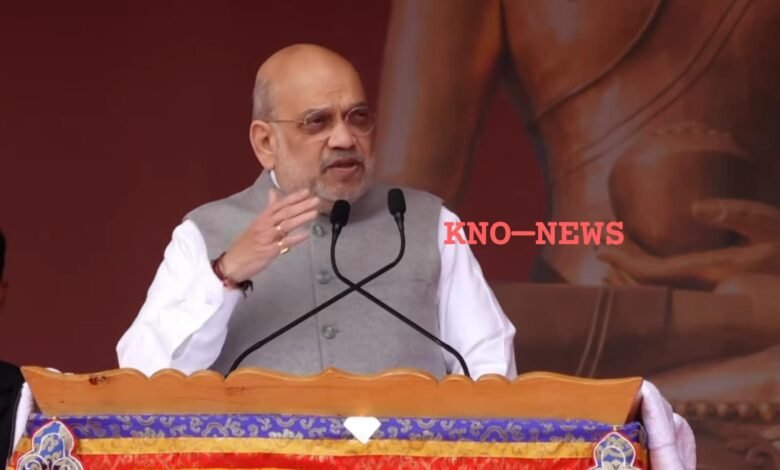
Leh, May 01 Union Home Minister Amit Shah on Friday said the return of sacred relics of Gautama Buddha to Ladakh after 75 years reinforces India’s long-standing message of peace and coexistence, calling the occasion a historic and spiritual moment on Buddha Purnima.
Addressing a gathering in Ladakh, Shah, according to the news agency—Kashmir News Observer (KNO) said the relics’ presence in Ladakh makes this year’s Buddha Purnima especially significant, allowing people across Ladakh, Kargil and other regions to experience their spiritual importance.
He said the development of infrastructure over the decades has ensured wider public access compared to 75 years ago, when limited connectivity restricted participation.
Shah said the occasion serves as a reminder that for thousands of years, India’s civilisation has conveyed a message of peace and coexistence, adding that this message becomes more relevant in diverse regions such as Ladakh and Kargil. He said that amid conflict and unrest, the path of peace and compassion remains the only viable solution.
Tracing the historical roots of Buddhism in the region, Shah said the religion reached Ladakh over centuries in different phases, flourishing locally before expanding beyond the region. He said Kashmir was once a major centre for Buddhist studies, Mahayana philosophy and art, and served as a gateway through which Ladakh engaged with Buddhist teachings.
He said emissaries of Emperor Ashoka laid the early foundations of Buddhism along the Kashmir-Gandhara route, including in Ladakh. He added that a second major phase occurred during the Kushan period between the 1st and 3rd centuries CE, when Mahayana Buddhism saw renewed growth and spread into Ladakh.
Shah said ancient stupas, rock-cut Buddhist sculptures and inscriptions in Kharoshthi and Brahmi scripts stand as evidence of Buddhism’s continued advancement in the region during that time.
He said the Silk Route linking Kashmir, Leh, Yarkand, Khotan and Tibet played a key role not only in trade but also in the exchange of ideas, manuscripts and artistic traditions among monks, scholars and artisans.
“These routes were not just commercial corridors but channels of intellectual and cultural transmission,” he said, adding that their legacy is still visible in rock inscriptions, Mani walls, stupas and Buddhist rock art across Ladakh.
Shah said the fourth phase of Buddhism’s development in the region was marked by the influence of Tibetan traditions, which further shaped Ladakh’s spiritual and cultural landscape.
He reiterated that the presence of the sacred relics underscores Ladakh’s historical role in preserving and promoting Buddhist teachings, and reflects India’s enduring civilisational ethos rooted in peace, compassion and coexistence—