DC Srinagar conducts onsite review of construction of Activated Carbon WTP Nishat for improving smell, colour, quality of water for major portions of Srinagar under

AMRUT 2.0
Emphasizes timely completion of the vital Water supply project to boost supply, quality of water across district
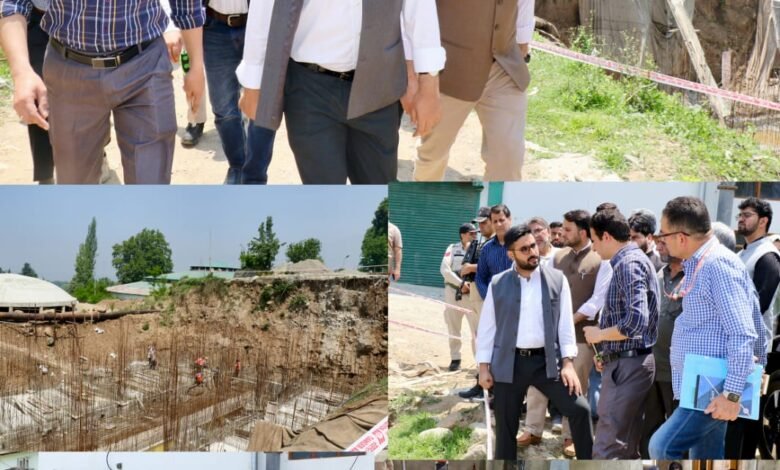
SRINAGAR, MAY 09: Deputy Commissioner (DC) Srinagar, Akshay Labroo today conducted an extensive onsite inspection of key ongoing water supply infrastructure projects being executed under Atal Mission for Rejuvenation and Urban Transformation (AMRUT) 2.0 aimed at strengthening and augmenting the supply and quality of drinking water in the district.
The DC was accompanied by Additional Deputy Commissioner, Mir Imtiyaz Ul Aziz, Chief Planning Officer, Fayaz Ahmad Dar, IAS Probationer, Alfred Thomas, Executive Engineer Water Works Division, Aijaz Rafiq, Executive Engineer I&FC, Executive Engineer PHE Mechanical, Javaid Ahmad, Executive Engineer UEED, Shabir Ahmad, Officers of PMU 2.0 and other concerned.
During the visit, the Deputy Commissioner inspected the progress of the ongoing construction of the 7 MGD Activated Carbon Chamber (ACC) at Water Treatment Plant (WTP), Nishat, a significant infrastructure initiative designed to enhance water treatment capacity and ensure improved drinking water quality for the city. He also reviewed the progress of the 0.1 MGD Water Supply Scheme (WSS) at Ishbar Nishat, including its distribution and coverage components intended to address water shortages in tail-end habitations of the area.
While reviewing the progress of the 7 MGD Activated Carbon Chamber at Nishat, the DC was informed that the project is being executed on a turnkey basis at an estimated cost of Rs 3.66 crore and is scheduled for completion by 31 December 2026.
On the occasion, the DC stressed the importance of maintaining execution timelines and ensuring strict adherence to prescribed quality standards. He observed that the project would play a crucial role in addressing seasonal water quality concerns and enhancing the overall reliability of the city’s drinking water supply system.
The DC stated that, once operational, the Activated Carbon Chamber would function as a critical tertiary-stage treatment barrier, ensuring consistent water quality throughout different seasons by effectively addressing variability in raw water characteristics. He further noted that the project represents a major transition from conventional treatment practices to a modern multi-barrier advanced water treatment system, thereby significantly strengthening Srinagar’s urban water infrastructure and public health safeguards.
During the inspection, the Executive Engineer Water Works Division, apprised the DC that the project is expected to address drinking water scarcity, particularly during lean seasons when discharge levels in Dachigam Nallah declines. He also informed that the system caters to an estimated population of over 6.5 lakh residents of Srinagar city and draws raw water primarily from Dachigam Nallah, while Dal Lake, Sarband and the SE Canal serve as supplementary water sources.
The DC was further informed that the 7 MGD Activated Carbon Chamber, designed as a tertiary treatment unit, is based on Granular Activated Carbon (GAC) technology, which will effectively remove colour, odour, taste-causing compounds and organic impurities, thereby improving the aesthetic as well as chemical quality of drinking water supplied to consumers.
Earlier, the DC also inspected the progress of the 0.1 MGD Water Supply Scheme at Ishbar Nishat being executed under AMRUT 2.0 at an estimated cost of Rs 1.13 crore which will improve water supply and addressing shortages in tail-end habitations, including Saado Colony, Dewaan Colony, Lone Mohalla and Ishbar Nishat.
The DC was apprised that the project includes upgradation of the existing Slow Sand Filtration Plant (SSFP), revamping of the 0.75 lakh gallon service reservoir, installation of a 1 lakh Gallon Rapid Sand Filtration Plant and allied infrastructure components. He was also apprised that all civil works under the project have been completed, while installation of electro-mechanical components is currently underway.
On the occasion, the DC directed the concerned Officers to ensure completion of the installation of electro-mechanical components by 25 May, 2026 so that the project is made operational at the earliest for the benefit of the local population.